If there is one area where Australian small business owners consistently leave money on the table, it is tax deductions. Not because the deductions do not exist, but because the people who could be claiming them either do not know they qualify, do not have the records to support the claim, or simply run out of time to think about it before June 30 arrives and the opportunity is gone.
The Australian tax system, through the ATO, is actually quite generous when it comes to what businesses can legitimately claim. The challenge is understanding what qualifies, what documentation you need, and how to approach the whole thing proactively rather than scrambling at the end of the financial year. This guide covers the most important categories of Australian business tax deductions and what you need to know to make the most of them.
What Makes an Expense Tax Deductible
Before diving into specific categories, it helps to understand the foundational principle behind ATO tax deductions. For an expense to be deductible, it generally needs to satisfy three conditions. It must be directly related to earning your assessable income. It must not be a private or domestic expense. And you must have records to prove it.
That last point is where many legitimate claims fall apart. The expense was real, the business purpose was genuine, but the documentation was never kept. Strong tax record keeping throughout the year is not optional if you want to claim everything you are entitled to. It is the foundation that every deduction rests on.
Operating Expenses You Can Claim Immediately
The broadest category of small business tax deductions covers the day-to-day costs of running your business. These are expenses you can typically claim in full in the year they are incurred, provided they meet the deductibility conditions.
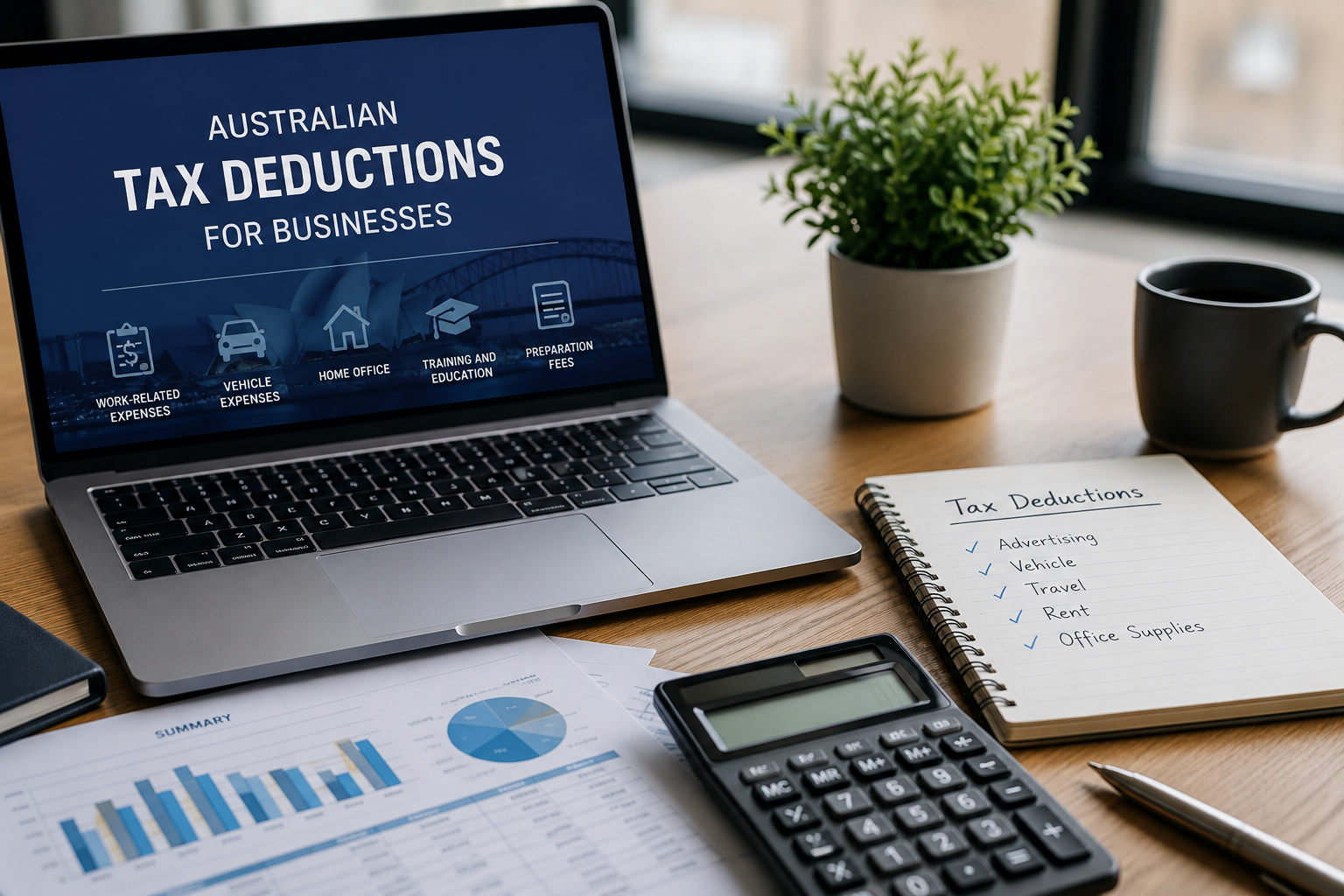
Tax-deductible business expenses in this category include:
- Accounting, bookkeeping, and legal fees
- Advertising and marketing costs, including website expenses and social media
- Bank fees and merchant transaction charges
- Business insurance premiums
- Employee wages, superannuation contributions, and on-costs
- Office supplies and stationery
- Rent on business premises
- Software subscriptions used for business purposes
- Telephone and internet costs for business use
- Repairs and maintenance on business assets
The key across all of these is that the expense must relate to the business. Where an expense has both business and personal components, only the business portion is claimable, and your records need to reflect that split clearly.
The Instant Asset Write-Off and Depreciation
For most business owners, asset purchases represent one of the largest and most impactful categories of Australian business tax deductions. Rather than depreciating an asset slowly over its effective life, eligible small businesses can use the instant asset write-off to claim the full cost of qualifying assets in the year of purchase.
This applies to both new and second-hand assets, provided they are purchased, installed, and ready for use before the relevant deadline. Equipment, machinery, tools, vehicles, technology, and fit-out costs can all potentially qualify depending on the applicable rules for your income year.
The instant asset write-off threshold and eligibility conditions have changed several times in recent years, so it is important to confirm the current rules with your accountant rather than assuming last year's conditions still apply. Getting the timing of major asset purchases right within the financial year can significantly shift your tax position, making this one of the most strategically valuable tools in tax planning in Australia.
Vehicle and Travel Deductions
Claimable business expenses related to vehicles and travel are significant for many business owners, but also among the most closely scrutinised by the ATO. Getting these claims right requires both accurate calculation and solid documentation.
For motor vehicles used partly or fully for business, you can claim using either the logbook method or the cents per kilometre method. The logbook method requires maintaining a detailed log of business versus personal use over a continuous twelve-week period, which then establishes the business use percentage applied to all vehicle costs, including fuel, insurance, registration, repairs, and depreciation. The cents per kilometre method is simpler but capped at a maximum number of kilometres per year.
Business travel expenses, including flights, accommodation, meals, and ground transport for genuine business purposes, are tax-deductible business expenses provided the primary purpose of the travel is business-related. Mixed trips that combine business and leisure require careful apportionment, and the ATO expects detailed records for travel claims, including itineraries, receipts, and a clear explanation of the business purpose.
Home Office and Home-Based Business Claims
With more Australians running businesses from home or working from home as part of a hybrid arrangement, home office deductions have become increasingly relevant. The ATO offers two main methods for calculating these claims, and choosing the right one for your situation can make a meaningful difference to your business tax write-offs.
The fixed rate method allows you to claim a set rate per hour for the hours you work from home, covering energy, internet, phone, and stationery costs. The actual cost method allows you to claim the actual expenses incurred for the work area of your home, including a proportional claim on occupancy costs like rent or mortgage interest, which requires a dedicated workspace used exclusively for business.
Whatever method you use, your tax record-keeping needs to support the claim. This means keeping records of the hours worked from home, the floor area used for business, and the actual costs incurred throughout the year.
Employee and Contractor Costs
Wages, salaries, superannuation contributions, and on-costs paid to employees are fully deductible in the year they are paid, provided they are reasonable for the work performed and properly documented. Superannuation contributions must be paid by the quarterly due date to be deductible in the relevant quarter, a detail that catches many employers out when they pay late and lose the deduction for that period.
Payments to contractors are also deductible as claimable business expenses, but the contractor relationship must be genuine and not a disguised employment arrangement. The ATO applies specific tests to determine worker classification, and getting this wrong creates both tax and compliance risks that go well beyond the deduction itself.
Professional Development and Business Education
Costs associated with maintaining or improving the skills you use in your current business are deductible as ATO tax deductions. This includes courses, seminars, industry conferences, professional memberships, and subscriptions to trade publications or professional journals.
The important distinction here is that the training or development must relate to your current income-earning activities. Costs associated with retraining for a new career or entering a different field do not qualify. Within those boundaries, though, investing in your professional development is not just good for your business. It is tax-effective as part of a broader tax planning Australia strategy.
Marketing, Advertising, and Digital Costs
Every dollar spent on promoting your business is generally a fully deductible business tax write-off in the year it is incurred. This covers a wide range of modern marketing expenses that many business owners underestimate or forget to claim, including website design and hosting, search engine advertising, social media management and advertising, content creation, email marketing platforms, and branding or design costs.
For businesses investing heavily in digital marketing, these costs can represent a significant portion of annual expenses and an equally significant portion of small business tax deductions available to them.
The Foundation: Tax Record Keeping
Every deduction in this guide depends on one thing. Tax record keeping that is accurate, organised, and maintained throughout the year, rather than assembled in a panic at tax time. The ATO requires most business records to be kept for a minimum of five years, and those records must be in a form that clearly supports every claim made.
Good record keeping means a consistent system for capturing receipts, invoices, bank statements, logbooks, and any other documentation relevant to your deductions. Cloud-based accounting software has made this significantly easier than it used to be, and the time invested in maintaining clean records throughout the year pays back many times over at lodgement time.
Work With Specialists Who Know This Inside Out
Understanding the full range of Australian business tax deductions available to your business, applying them correctly, and maintaining the records to support every claim is a year-round commitment that goes well beyond lodging an annual return.
R&K Taxation Experts works with Australian business owners across multiple industries to build proactive tax planning Australia strategies that maximise legitimate deductions, minimise tax liability, and ensure full compliance with ATO requirements. From identifying tax-deductible business expenses you may have been missing to reviewing your overall structure and approach, R&K Taxation Experts delivers specialist support that makes a genuine financial difference to the businesses they work with.